
California's Infamous Stage Robber
INTERESTING TRIVIA
Must have been a slow news day
Eastern newspapers (known to romanticize western outlaws) printed many
stories that had no basis in fact.
For example, the New York Dailey Times printed a story that had Black
Bart robbing trains. Bart never was a train robber.
In 1946 a reporter for the New York World Telegram reported this story
in a Sunday feature about Bart’s first robbery: Professor Charles Bowles, a
mild-mannered schoolteacher in Sierra County, locked up his schoolhouse for
the day and noticed an approaching stagecoach. As a joke he tied a handkerchief
over his face, picked up a stick which looked like a rifle, and called to the
driver to halt his stage and throw down the box. The box burst open when it hit
the ground and the penurious teacher found himself staring at more money than
he'd ever seen. Robbery being so easy, he quit teaching and went on the road
as a highwayman.
There is so much wrong with this story that it is obvious that the author had
no respect for the facts. But, it is just one of the many myths that have been
spawned by the legend of Black Bart.
The "Black Bart" of the Upper Peninsula.
Black Bart in Michigan? What was he doing there? Well he wasn't, but
Reimund Holzhey was. Holzhey was a really bad man and robber that sometimes
carried a rifle and two guns. Now you ask what possible connection could
there be between Reimund Holzhey and Black Bart? Well, here it is: In his
day Reimund Holzhey was know as the "Black Bart" of the Upper Peninsula.
He was, for a time (five months), the terror to all who were obliged to travel
by other than rail in the Gogebic district. Holzey took Bart's name after reading
about him in a dime novel, sort of a off-hand compliment to Bart. However,
the real Black Bart never shot or killed anybody.
Reimund Holzhey's last robbery had a little history to it:
On August 26, 1889 the last stagecoach robbery east of the Mississippi River was
in Gogebic County, Michigan, on the road from Gogebic Station to The Gogebic Hotel.
During the robbery a passenger decided to be a hero and pulled a gun and started
shooting. The robber fired back, the shooter and an innocent passenger (possibly shot
by the shooter not the robber) were wounded and the passenger later died. The robber,
Reimund Holzhey, escaped. Three days after the robbery Holzhey arrived in Republic,
Michigan, and checked into the hotel as Henry Plant but, the hotel manager recognized
him and called the sheriff. The next morning as he left the hotel they arrested him.
Holzhey served 23 years in prison and was released. Holzhey died in 1952 of suicide.
A Hole in a Tree
There is a story that Black Bart had an affair with a woman that lived on a ranch near Petaluma, California in Sonoma County. On the ranch there is a tree, where at the base of it, a large section of bark (about 3'x3') was perfectly cut out to reveal a 'hole' within the tree. Basically, the 3x3 piece of bark acted like a lid over the 'hole.' Allegedly Black Bart used this to hide cash in during his travels. Could this be the mystery women? Today that tree is on the property of the Bush-Field Estate Vineyards & Winery. If you ask them about it, maybe they will show it to you.
Setting the Table for Black Bart
A story from Mendocino County, California:
A lady said her great grandmother always set an extra place
at the table for Black Bart. The story is
that all the ranchers up and down the valley kept a place for
him at their supper table so that he could join them if he were in
the area. If they did this, then Bart would not rob them.
HI HO ...... no one
Unlike all the other bad guys, Black Bart never used a horse in any of his robberies.
Throw down that strong box
In every robbery Bart jumped out in front of the coach, pointed a 12 gauge shotgun at the driver and demanded the strong box. He never fired a shot or harmed anyone. After his capture, in an interview, Bart told Thorn, Stone and Morse that he never even loaded the gun.
Black Bart's Shotgun
In all his robberies Bart used a 12 gauge breach loading shotgun. It has been incorrectly identified as a 10 gauge shotgun by some sources. Bart never carried or used a hand gun. His first robbery was the only time Bart carried two guns. His primary gun was the shotgun and strung over his sholder Bart had a Henry rifle that he later sold. The Henry rifle was a 44 caliber rifle that was sometime called a sixteen shooter. An interesting side note is the Henry rifle was the source for the saying, "That damned Yankee rifle that can be loaded on Sunday and fired all week."
Where is the Reynolds Ferry?
November 3, 1883 stage driver, Reason E. McConnell stopped at the Reynolds Ferry Hotel on the Stanislaus River. He picked up Jimmy Rolleri, headed for Funk Hill, and the last robbery of Black Bart. Today the Reynolds Ferry and the hotel are at the bottom of the New Melones Lake. New Melones Lake is a reservoir behind the New Melones Dam, on the Stanislaus River, between the cities of Angels Camp and Sonora in the central Sierra Nevada foothills of California. Upon the dam's completion, the valley filled with water, covering the old mining town of Melones, the original Melones Dam and old location of the Reynolds Ferry. The New Melones Lake provides irrigation water, hydroelectric power, flood control, wildlife habitat, fishing, camping, boating, and other recreation as part of the Glory Hole Recreation Area.
Dime Novels
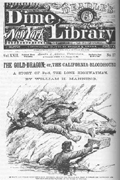
About three months after Bart entered prison, one of the many Dime Novels about him came out.
Bart was immortalized by the Beadle & Adams Dime Library publication of W.H. Manning's "The
Gold Dragon; or, the California Bloodhound:" The story of Black Bart the Po8, the Lone Highwayman.
The book bore no resemblances to the exploits of Black Bart or any historical events. It was sensational,
however, and was designed to draw attention and sell books. It was the true Dime Novel, lots of action and
few true facts, if any.
Black Bart the Movie
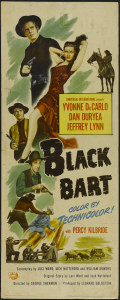
In 1948 the movie "BLACK BART" was released by Universal
Studios. The 80 minute color movie starred Yvonne De Carlo and Dan
Duryea. Duryea played the part of Black Bart (Charles E. Boles). The
screen writers, headed by Luci Ward, did not care for historical fact
but instead chose to grab the name of Black Bart and write a movie that
had absolutely no resemblance to the real Black Bart.
Synopsis
Worthless as history, Black Bart is nonetheless an enjoyable
fabrication about the fabled western outlaw. Rescued from a
"necktie party," outlaws Charles E. Boles (Dan Duryea) and
Lance Hardeen (Jeffrey Lynn) decide that it would be best to part
friends and go their separate ways. When next seen, Boles is a
prosperous rancher who supplements his income by robbing the Wells
Fargo gold shipments under the alias of Black Bart. Upon learning this,
Hardeen rides back into Boles' life demanding a piece of the action.
Both of the hero-villains are foiled when they succumb to the charms of
the bewitching international courtesan Lola Montez (Yvonne DeCarlo).
The story is related in flashback-from a jail cell-by the outlaw's
erstwhile partner Jersey Brady (Percy Kilbride).
Black Bart the TV Series
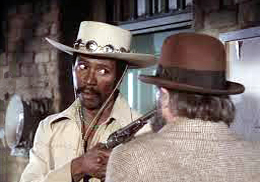
In 1975 a pilot for a Black Bart TV series was created. It starred Lou
Gosette, Millie Slaving, Nobel Willingham and Steve Lansberg. It was
directed by Robert Boiler. The TV series was modeled after the Mel Brooks
movie Blazing Saddles, using all the same characters
CBS and Warner Bros made a deal. The deal was that CBS would get to air Blazing Saddles,
and any sequels from the movie, in exchange for co-producing a TV show. But Mel Brooks had a clause
in his contract that said Warner had to keep producing Blazing Saddles stories, in the movies or TV,
or they'd lose the rights to make sequels. The TV show was a way to keep the rights. They didn't have
to air it, just keep producing it. After four years they finally figured out the market had changed
and they weren't going to make any sequels, so the show that was never to air was cancelled.
CBS made six episodes each year. The pilot episode of Black Bart was included as a bonus feature on
the Blazing Saddles 30th Anniversary DVD and Blu-ray disc. To date, the pilot episode is the
only episode of Black Bart that has ever been released publicly.
Note:
A little extra piece of trivia: Blazzing Saddles was originally titled Black Bart.
It is hard to believe what possible relationship to Black Bart there
could be in the movie or TV series. The only thing I can see in common
with Black Bart is that both the movie and TV series had a stagecoach in them.
The Wells Fargo Treasure Box
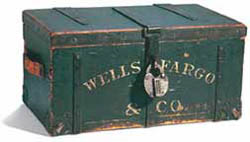 Gold dust, gold bars, gold coins, legal papers, checks, and drafts traveled
in the famous green treasure boxes, stored under the stagecoach driver's seat.
Loaded with bullion, they could weigh from 100 to 150 lbs. "About as much as
one likes to shoulder to and from the stages," wrote John Q. Jackson, Wells
Fargo agent, in an 1854 letter to his father. Because they carried the most
valuable assets of the West, these sturdy boxes of Ponderosa pine, oak, and
iron were more prized by highway bandits than anything else.
Gold dust, gold bars, gold coins, legal papers, checks, and drafts traveled
in the famous green treasure boxes, stored under the stagecoach driver's seat.
Loaded with bullion, they could weigh from 100 to 150 lbs. "About as much as
one likes to shoulder to and from the stages," wrote John Q. Jackson, Wells
Fargo agent, in an 1854 letter to his father. Because they carried the most
valuable assets of the West, these sturdy boxes of Ponderosa pine, oak, and
iron were more prized by highway bandits than anything else.
But the real security of the treasure boxes came from who was guarding them –
the Wells Fargo shotgun messengers. Thieves who were foolhardy enough to try
and steal a treasure box would find themselves staring down the barrel of a
sawed-off shotgun, loaded with 00 buckshot.
The Concord Coach
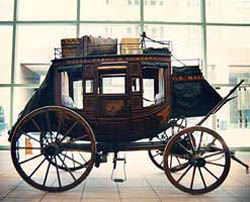 Built high and wide to handle the rough, rutted roads of a new country, the
design of a classic American vehicle was perfected in Concord, New Hampshire.
Carriage builder J. Stephens Abbot and master wheelwright Lewis Downing built
the famed stagecoaches of Wells Fargo & Co.
Concord Coaches weighed about 2,500 pounds, and cost $1,100 each, including
leather and damask cloth interior.
Built high and wide to handle the rough, rutted roads of a new country, the
design of a classic American vehicle was perfected in Concord, New Hampshire.
Carriage builder J. Stephens Abbot and master wheelwright Lewis Downing built
the famed stagecoaches of Wells Fargo & Co.
Concord Coaches weighed about 2,500 pounds, and cost $1,100 each, including
leather and damask cloth interior.
The curved frame of the body gave it strength, and perhaps a little extra
elbow room. Perfectly formed, fitted, and balanced wheels stood up to decades
of drenching mountain storms and parching desert heat. The unique feature of
these coaches was the suspension. Instead of steel springs, the coach body
rested on leather "thoroughbraces," made of strips of thick bullhide. This
feature spared the horses from jarring and gave the stagecoach a (sometimes)
gentle rocking motion, leading Mark Twain to call it, "An imposing cradle on wheels."
Mud Wagon
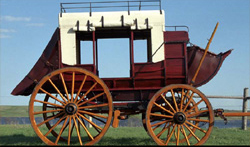 While the Concord Coach was considered the 'Star of the Road,' the Passenger Wagon, also
called the Celerity Coach, was the true work horse. The advantage of the passenger wagon
and the origin of its nickname, Mud Wagon, was the lightness that enabled it to pass frequently
over poor and soft roadways, through mud holes, or up steep mountainous slopes. These light
semi-enclosed carriers are equipped with canvas or enameled leather storm curtains, and brakes
for mountain travel.
While the Concord Coach was considered the 'Star of the Road,' the Passenger Wagon, also
called the Celerity Coach, was the true work horse. The advantage of the passenger wagon
and the origin of its nickname, Mud Wagon, was the lightness that enabled it to pass frequently
over poor and soft roadways, through mud holes, or up steep mountainous slopes. These light
semi-enclosed carriers are equipped with canvas or enameled leather storm curtains, and brakes
for mountain travel.
The Mud Wagons are lighter and the wheels are three inches wide, as opposed to Concord's two-inch
wheels. With its outside framing and square body they were less expensive to build and durable in
service. These vehicles cost about 35% of what the Concord cost to build. The body of these wagons
are bolted to iron rockers that, in turn, rest on leather thoroughbraces. The body measures from
6'10" to over 8' high, the track 5'2" (in the U.S.) or 4'8" (in Canada), and it weighs from 800 pounds,
for the commonest nine-passenger model, to 1200 pounds for a 18 passenger. It has two to three inside
seats (no roof passengers), and baggage is stored in the single rear boot or piled inside with the
passengers. Up front is the driver and shotgun rider. Selection of the type of stage to use might
be determined by availability, the terrain – such as mud or soft sand, and the passengers and cargo
to be carried in each direction.
The Mud Wagon was often employed in hostile Indian country, where the Concords might be too valuable
to risk. Indians were likely to set the coach afire if they took it. For the driver's sake, the
front boot and the seats were protected by sheet metal, heavy enough to stop an arrow and perhaps a bullet.
Mary Vollmer
Of the many stories about Bart there is the story about Bart and Mary Vollmer, his supposed mistress. There is virtually no evidence of a affair between Bart and Mary Vollmer. Although many claim there was a woman who remained devoted to Bart during his last years in California. There is one story that Bart and Mary left California and settled in Pennsylvania where they lived out their lives. Outside of some family contradictory stories no one can document what happened to Bart.
1800s rules for stage passengers
Some of the rules for proper stagecoach etiquette posted by Wells-Fargo might still be applicable for bus
and auto passengers of today.
- Abstinence from liquor is requested, but if you must drink, share the bottle. To do otherwise makes you appear selfish and unneighborly.
- If ladies are present, gentlemen are urged to forego smoking cigars and pipes as the odor of same is repugnant to the Gentle Sex. Chewing tobacco is permitted but spit WITH the wind, not against it.
- Gentlemen must refrain from the use of rough language in the presence of ladies and children.
- Buffalo robes are provided for your comfort during cold weather. Hogging robes will not be tolerated and the offender will be made to ride with the driver.
- Don’t snore loudly while sleeping or use your fellow passenger’s shoulder for a pillow; he or she may not understand and friction may result.
- Firearms may be kept on your person for use in emergencies. Do not fire them for pleasure or shoot at wild animals as the sound riles the horses.
- In the event of runaway horses, remain calm. Leaping from the coach in panic will leave you injured, at the mercy of the elements, hostile Indians and hungry coyotes.
- Forbidden topics of discussion are stagecoach robberies and Indian uprisings.
- Gents guilty of unchivalrous behavior toward lady passengers will be put off the stage. It’s a long walk back. A word to the wise is sufficient.
Captain Bartholomew Roberts, Pirate ---- aka The Great Pirate Roberts or Black
Bart
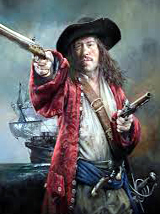
Bartholomew Roberts was tall, dark, handsome & very brave, though
this personal bravery was used for wicked purposes. He was a very
snazzy dresser, adorning himself in a rich waistcoat and breeches, a
hat with a red feather and his diamond cross which hung on a heavy gold
chain around his neck. During battle, he carried two pairs of pistols
at the end of a silk sling across his shoulder. His fellow pirates
thought he was a bit of a dandy when it came to his choice of attire,
though his valor was never questioned.
Roberts (Black Bart) was killed aboard his ship, the Royal Fortune, on
February 5, 1722, in a battle with the warship Swallow.
Home | Why Bart | Legend Begins | C.E. Boles | Legend Ends | Prison | Robberies | Family Tree | Trivia | Plaque | ????
Want to contact us? E-mail the Webmaster